
Research

Research themes in integrated photonics

Research is organized by physical and computational theme, with full-wave electromagnetic simulation and device physics as the underlying methodology connecting structural geometry to optical and electrical behavior.

Integrated Nanophotonics

Topic publications
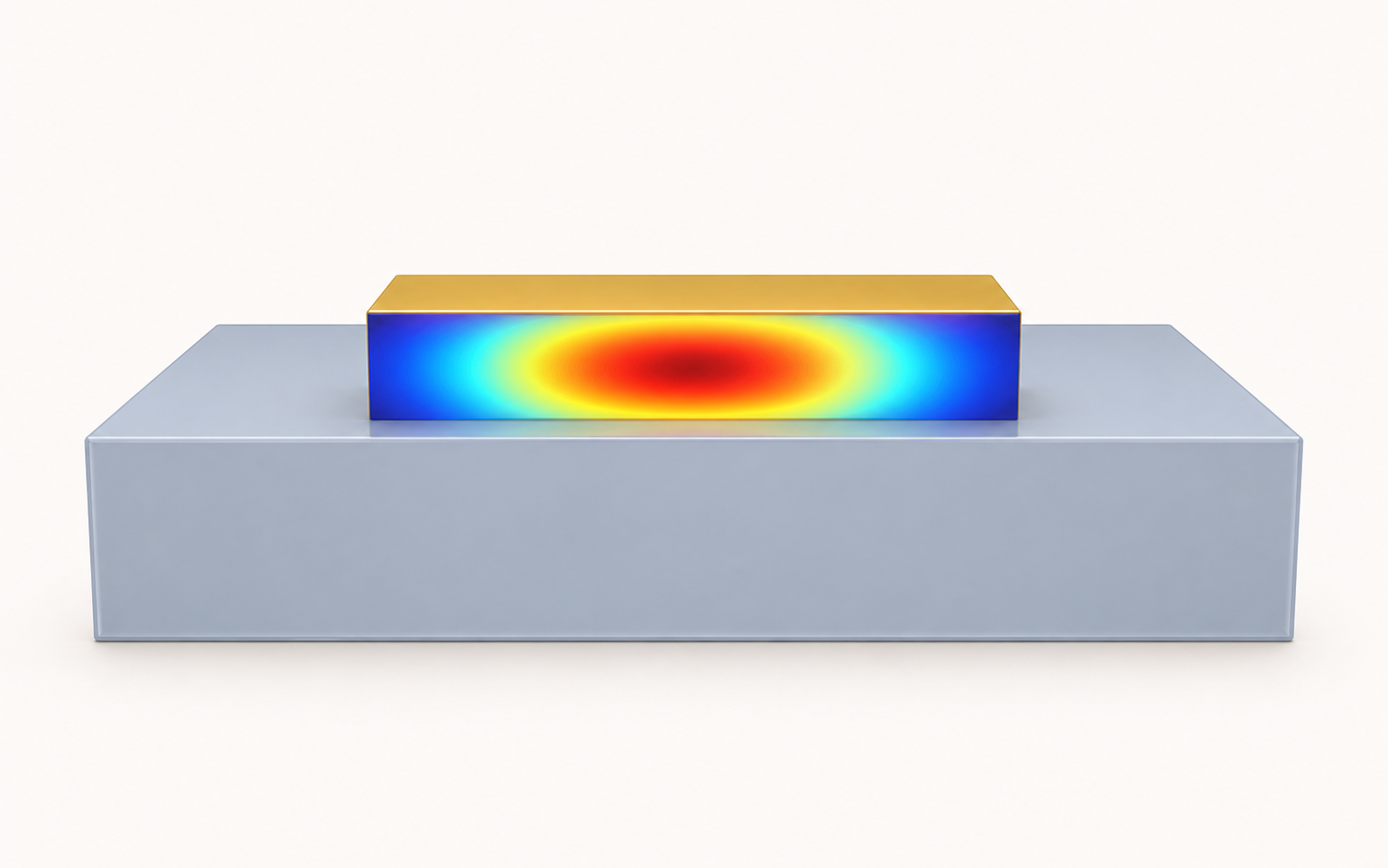
TOC figure for Integrated Nanophotonics

Mode profile / structure

Problem
Harnessing the interaction between guided optical modes, hybrid active materials (ferroelectrics, liquid crystals, 2D layers), and surrounding acoustic, thermal, or electrostatic fields in cavity, photonic crystal, plasmonic, and bound-state-in-the-continuum (BIC) structures.
Methods
Full-wave electromagnetic simulation, anisotropic permittivity tensor modeling, multi-physical finite-element coupling, waveguide dispersion engineering, and resonant cavity analysis.
Physical Relevance
External stimuli and material responses dynamically modify the local permittivity tensor, shifting resonances and tuning propagation constants. Modeling these optoacoustic or electro-optic couplings enables active tunability, reconfigurability, and switchable light routing on-chip.
Quantum Photonics

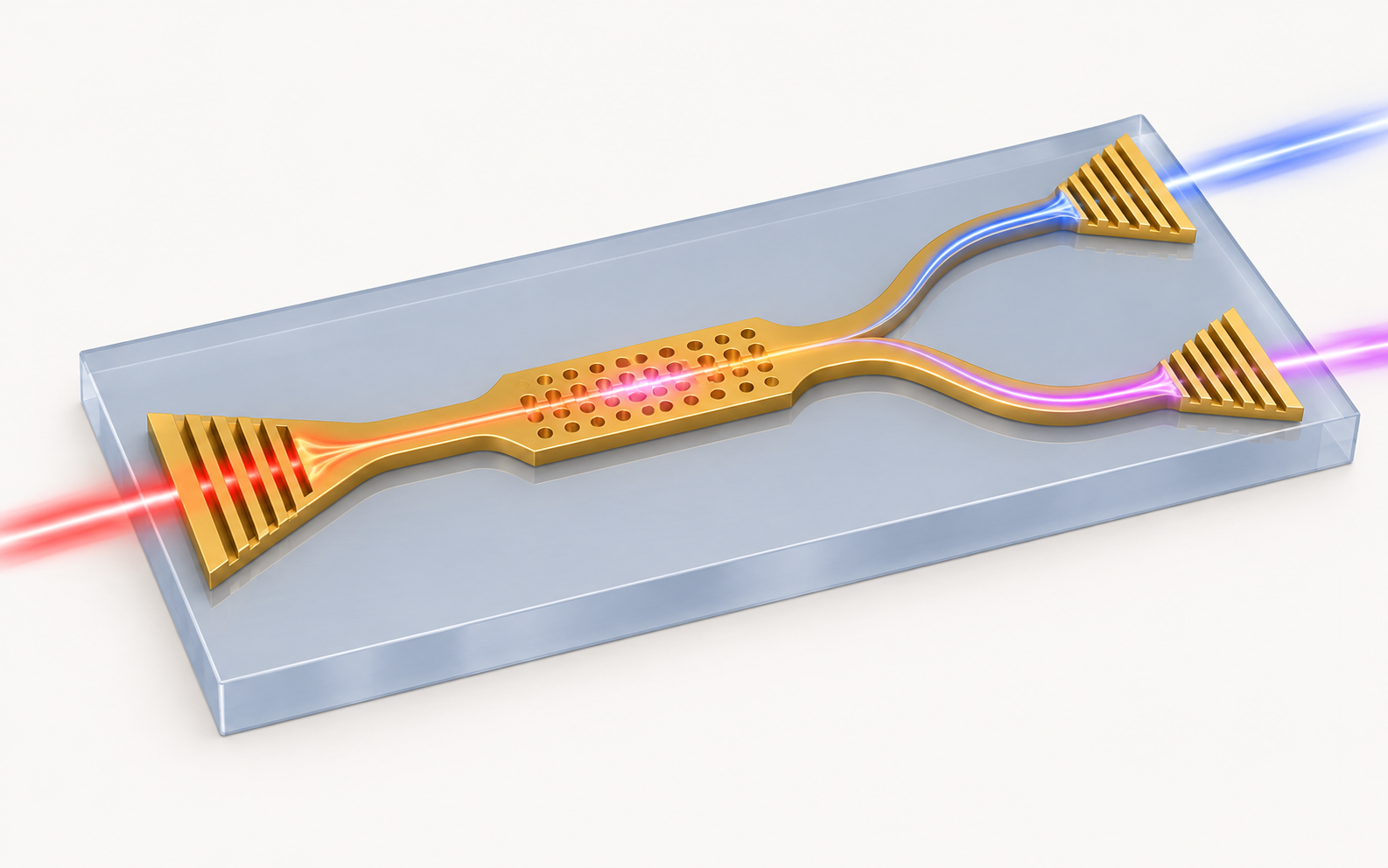
TOC figure for Quantum Photonics

Mode profile / structure

Problem
Scaling on-chip quantum technologies by co-integrating waveguide-based nonlinear photon-pair sources, coherent interfaces, and phase-shifter networks within the low-loss routing topologies established on the nanophotonic platform.
Methods
Nonlinear optics modeling, quantum state tomography representation, coherent waveguide interface simulation, and reconfigurable circuit design.
Physical Relevance
Governing waveguide nonlinear coefficients and coherent interactions to execute high-fidelity quantum state preparation, routing, and manipulation in photonic circuit topologies.

Intelligent Photonics

Topic publications
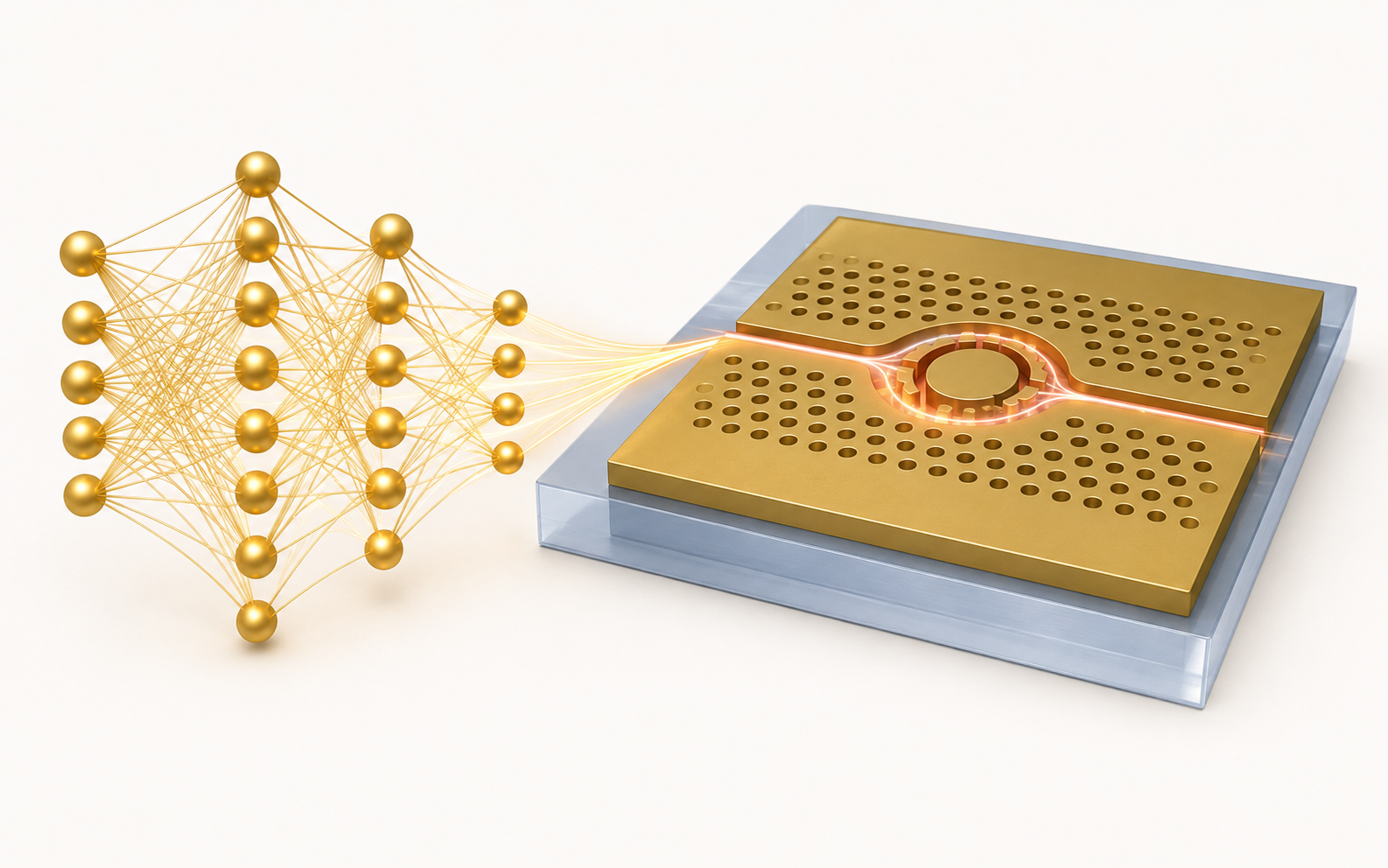
TOC figure for Intelligent Photonics

Mode profile / structure

Problem
Accelerating device design and discovery by bridging wave equations with deep learning and optimization methods, while developing all-optical neuromorphic processing hardware.
Methods
Physics-informed neural networks (PINNs), adjoint and gradient-free optimization, evolutionary search algorithms, optical neural network (ONN) architectures, and wave-based co-design.
Physical Relevance
Establishing a bidirectional framework where physical wave propagation constrains network training, and multi-port interferometric circuits execute mathematical operations at the speed of light.